For most 3D printing beginners, support structures are the biggest headache. They add to print time and filament waste, and removing them often damages the surface of the model, leaving behind ugly marks. However, by choosing the right models and adjusting the orientation, you can print many practical household items without any supports at all. This article features 10 household items that are used frequently in daily life. Each one has been verified for support-free printing and includes suggested key parameters so you can start printing right away.
Why Choose Support-Free Models?
Before looking at specific categories, it is important to understand the engineering logic behind support-free printing.
- Save on Filament: Support structures usually take up 10% to 25% of total filament use. Printing without supports directly reduces material costs.
- Shorten Print Time: By removing the steps for support generation and printing, you can reduce total print time by 20% to 40%.
- Improve Surface Quality: The areas where supports touch a model often leave rough marks. Support-free models maintain more consistent surface quality on both the bottom and sides.
- Lower the Risk of Failure: Improper support removal is a common cause of damage to functional parts.
The core principle of support-free printing is ensuring all overhanging structures stay under a 45 degree angle or using design techniques to avoid horizontal cantilevers.

10 High-Value Support-Free Home 3D Prints
1. Wall-Mount Key Rack
An entryway essential that solves the daily frustration of searching for your keys.
- Recommended Layer Height: 0.2mm
- Infill: 30%
- Material: PETG (More reliable for load-bearing wall mounts)
- Print Time: Approx. 1 to 1.5 hours
- Support-Free Tip: The hooks use an inward-leaning angle. By keeping the overhang below 45°, the part prints perfectly without supports.
- Installation Advice: The backplate includes pre-drilled M3 screw holes for fixing to the wall with expansion bolts.
2. Phone & Tablet Charging Stand
A desk staple that supports your device while charging, compatible with various sizes.
- Recommended Layer Height: 0.2mm
- Infill: 20%
- Material: PLA or PETG
- Print Time: Approx. 1 to 2 hours
- Support-Free Tip: The base and support arms use a progressive slope. The maximum overhang angle stays under 40°.
- Practical Detail: The slot width is designed at 12 to 15mm to fit most phone cases.
3. Cable Management Clip
Organize messy USB, headphone, and power cables on your workspace.
- Recommended Layer Height: 0.25mm
- Infill: 15%
- Material: PETG (Better elasticity than PLA, so the clip won’t snap)
- Print Time: Approx. 20 to 35 minutes per unit
- Support-Free Tip: Place the clip with the opening facing up. This uses bridging to cross the gap. Keep the bridge distance under 8mm.
- Batch Strategy: Print 8 to 10 units at once. The total time only increases by about 30%.
4. Kitchen Spice Jar Label Holder
A small detail that brings professional-level organization to your kitchen.
- Recommended Layer Height: 0.2mm
- Infill: 20%
- Material: PETG (Better food-contact safety than ABS)
- Print Time: Approx. 30 to 45 minutes
- Support-Free Tip: The label slot is tilted forward at 15°, completely avoiding horizontal overhangs.
- Customization: Use Tinkercad to add embossed text directly to the label surface, removing the need for stickers.
5. Door Stopper / Curtain Clip
Simple, high-frequency household items. PLA works well for most indoor uses.
- Recommended Layer Height: 0.3mm (Low aesthetic requirement allows for faster printing)
- Infill: 25%
- Material: PLA
- Print Time: Approx. 30 to 50 minutes
- Support-Free Tip: Wedge-shaped stoppers have no overhangs by design. Print curtain clips with the opening facing up to stay support-free.
- Material Upgrade: Use ASA for outdoor curtain clips for better UV resistance.
6. Modular Desk Organizer
Modular design is the core of this project. Print multiple units and snap them together.
- Recommended Layer Height: 0.25mm
- Infill: 15% (Storage only, no heavy loads)
- Material: PLA
- Print Time: Approx. 1.5 to 2.5 hours per module
- Support-Free Tip: Vertical walls and an open top eliminate all overhangs.
- Pro Tip: Use different colors for each module to add visual depth to your desk.
7. Self-Watering Plant Funnel
A handy tool for gardeners. Insert it into the soil for slow, guided irrigation.
- Recommended Layer Height: 0.2mm
- Infill: 20%
- Material: PETG (Better weather resistance for long-term contact with water and soil)
- Print Time: Approx. 45 minutes to 1 hour
- Support-Free Tip: The funnel shape is wider at the top, naturally avoiding overhangs. The drainage tube uses a tapered end.
- Practical Detail: Use a 2 to 3mm drainage hole to control the water flow rate.
8. Fridge Magnetic Clip
Turn the side of your fridge into storage for sticky notes, shopping lists, or small tools.
- Recommended Layer Height: 0.2mm
- Infill: 30%
- Material: PLA
- Print Time: Approx. 30 to 45 minutes
- Support-Free Tip: The magnet slot is open at the top. Simply press the magnet in after printing.
- Magnet Specs: Use 10mm x 3mm Neodymium magnets. They are strong and easy to find.
9. Book Stand / Page Holder
A reader’s companion for the kitchen or desk that frees up your hands.
- Recommended Layer Height: 0.2mm
- Infill: 20%
- Material: PLA or PETG
- Print Time: Approx. 1.5 to 2 hours
- Support-Free Tip: The support arms use a triangular rib design. This makes the structure self-supporting.
- Anti-Slip Detail: The bottom features a corrugated texture or slots for silicone pads to keep it stable.
10. Bathroom Toothbrush Holder
A high-demand item for organizing bathroom counters. Works for wall-mount or tabletop use.
- Recommended Layer Height: 0.2mm
- Infill: 25%
- Material: PETG (Much better moisture resistance than PLA)
- Print Time: Approx. 1 to 1.5 hours
- Support-Free Tip: The toothbrush slots are vertical holes, so there is no overhang. The drainage holes also point straight down.
- Hygiene Tip: PETG has a smooth surface that resists bacteria buildup, making it perfect for the bathroom.
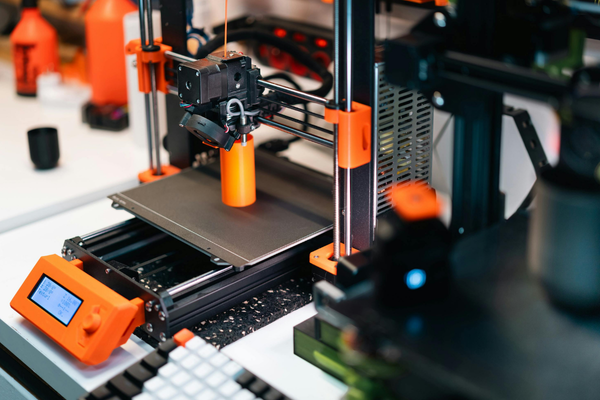
If you want a machine that can reliably print these home items with ease, the best hobby 3d printer, Flashforge Adventurer 5X, is a top contender. Its auto-levelling system and quick-release nozzle significantly lower the barrier to entry. It is perfect for users focused on practical home printing.

Key Parameters to Improve Support-Free Printing Success
Even for models designed without supports, the following configurations will significantly impact final quality:
Bridging Settings
Some support-free models rely on short-distance bridges to span openings:
- Bridging Speed: Reduce to 50% to 60% of your normal speed (roughly 20 to 30mm/s).
- Bridging Cooling: Run the fan at 100% to harden the material quickly and prevent sagging.
- Maximum Safe Bridge Distance: Approximately 50mm for PLA and 30mm for PETG.
First Layer Parameters
- First Layer Speed: Use 25% to 30% of your normal speed to ensure strong adhesion.
- First Layer Height: Set this to 120% of your standard layer height to increase the mechanical bond with the heat bed.
- Bed Temperature: 60°C for PLA and 75 to 80°C for PETG.
Model Orientation Optimization
- Place the largest flat surface on the bed to maximize the contact area.
- For structural parts with openings, prioritize placing the opening facing upward.
- Rotating the model to avoid overhangs is always better than adding supports.
Why Flashforge is Ideal for Home 3D Printing
Most people find that after buying a 3D printer, it eventually moves from the desk into a storage closet. This is usually not because the machine is bad, but because it is too much trouble. Maybe it is too loud to run, the leveling takes too much patience, or sourcing specific filaments feels like a chore.
Flashforge has built a strong reputation in the home market for one reason: they make printers that fit into your life rather than disrupting it. With operating noise levels kept below 45dB, you can run a print in your home office without disturbing someone reading nearby. Fully automatic leveling means it is ready to go as soon as you turn it on, removing the need for tedious prep work before every print. The open filament ecosystem supports standard materials like PLA, PETG, and TPU, so you never have to worry about buying the wrong kind. Additionally, the compact frame fits easily on a shelf without taking up too much space. In many ways, it feels more like a household appliance than a piece of industrial equipment.
If you want a 3D printer that does not require constant babysitting, but is instead ready whenever you need it, a reliable home 3d printer like the Flashforge Adventurer 5M Pro is one of the most hassle-free choices for a home environment today.
Conclusion: Making Your 3D Printer Truly Useful
For everyday hobbyists, the ultimate value of 3D printing lies in the real convenience it brings to your daily life. Each of the 10 support-free home prints mentioned above has been verified in real-world scenarios, balancing practicality with ease of printing. Thinking in a support-free way is a major step in advancing your 3D design skills. When you start designing to avoid supports instead of relying on software to generate them, your understanding of FDM technology reaches a new level. Start with these 10 items and let your printer become a true tool for home improvement.