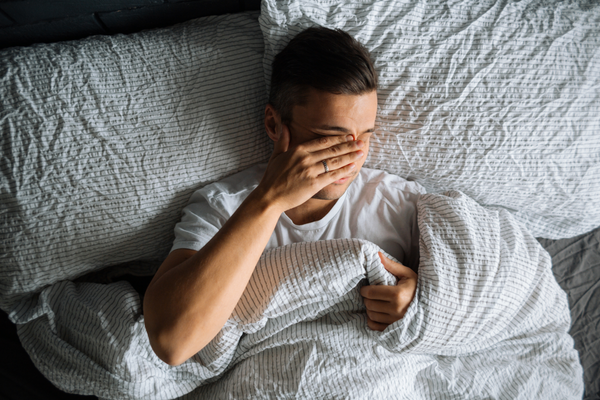
Waking up in the middle of the night with a soaked shirt or damp sheets is one of the most common sleep complaints, and one of the most frustrating. It’s not just uncomfortable — it interrupts sleep at exactly the stages the body needs most, forcing a restart on the cycle of deep and REM sleep that keeps you functional the next day. If this happens more nights than not, the culprit is usually simpler than people assume: it’s not always the body overheating on its own, but the mattress trapping heat that has nowhere to go.
What Causes Night Sweats
Night sweats can come from a range of sources — hormonal shifts, certain medications, stress, or simply a bedroom that runs warm. But even when the cause is otherwise healthy, like a naturally warmer body temperature or a partner who prefers a toastier room, the mattress itself plays a bigger role than most people realize.
Standard mattresses and memory foam in particular are dense materials that hold onto body heat instead of releasing it. Combine that with sheets, blankets, and a partner’s body heat, and the small pocket of air between a sleeper and the mattress can turn into a heat trap well before 2 a.m. That trapped heat is often what pushes the body into a sweat response, even in a bedroom that felt perfectly comfortable at bedtime.
Why Fans and AC Don’t Always Help
The instinct is usually to crank the air conditioning or point a fan at the bed, and both can help a little. But neither one addresses the actual problem, which is heat buildup at the surface where the body is making direct contact for eight hours a night. Air cooling has to work its way through blankets and sheets before it reaches skin, and by the time it does, much of its effect is lost. It also means cooling an entire room to the temperature one overheated sleeper needs, which can leave the rest of the household reaching for extra blankets.
This is why more people dealing with chronic night sweats are turning to solutions that cool the sleeping surface directly, rather than the air around it.
A Direct Fix: Cooling the Mattress
A cooling mattress topper for night sweats works differently than a fan or a lower thermostat setting. Sleepme’s Chilipad 2.0 uses a water-based system that circulates temperature-controlled water through a pad placed directly under the sheets, actively pulling heat away from the body instead of just blowing air across the room. Water conducts heat far more efficiently than air does, which is part of why this kind of surface-level cooling tends to produce a more noticeable difference for people who consistently wake up overheated.
The system covers a wide range, cooling down to 55 degrees Fahrenheit or warming up to 115, so it can handle everything from a sweltering summer night to a partner who runs cold. For couples, dual-zone versions let each side of the bed be set independently, which solves the common problem of one person wanting it cold and the other wanting it warm. Settings can be adjusted through a bedside remote or a phone app, and a scheduling feature can automatically shift the temperature partway through the night, since the ideal sleep temperature isn’t the same at midnight as it is right before waking.
What to Look for If You’re Considering One
Not every cooling mattress topper is built the same way, and for anyone shopping around because of persistent night sweats, a few features are worth prioritizing:
- A wide, adjustable temperature range rather than a fixed “cool” setting, since needs can shift by season or even by night
- Dual-zone control if the bed is shared, so one person’s preference doesn’t override the other’s
- Quiet operation, since a noisy pump can trade one sleep disruptor for another
- No required subscription for basic temperature control, so the core cooling function isn’t locked behind ongoing fees
The Bottom Line
Night sweats can feel like a mystery, but the fix often isn’t about diagnosing some hidden cause — it’s about addressing the mattress itself, which is usually the actual source of the trapped heat. Cooling the sleeping surface directly, rather than trying to chill an entire room, tends to make a bigger and more immediate difference for people who wake up overheated night after night. For anyone who’s tried lowering the thermostat, switching to lighter sheets, or running a fan without much luck, a targeted cooling system aimed at the mattress itself is often the missing piece.