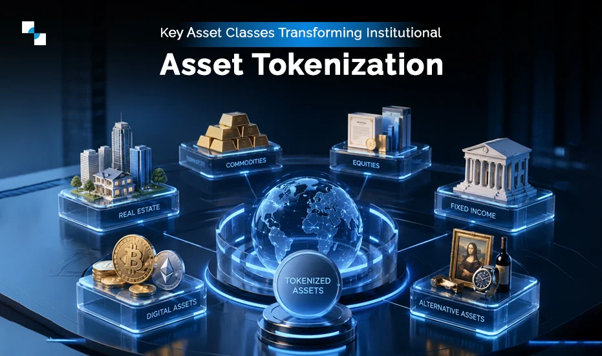
Institutional interest in asset tokenization has moved well beyond conceptual discussion. Enterprises across financial services are now expected to articulate a specific position on which assets warrant tokenization, rather than a general view on the technology itself. This shift has exposed a gap in most internal strategy conversations: technical feasibility is rarely in question, but the criteria for selecting the right asset class often are. Boards and investment committees increasingly expect a defensible rationale for that selection, rather than a general statement of interest in the category. This article examines which asset classes are attracting genuine institutional activity and the reasoning that explains why.
Committing resources to the wrong tokenized asset classes can delay a tokenization program by an entire planning cycle, since the legal, custodial, and regulatory groundwork differs meaningfully across asset types. A treasury desk exploring short duration instruments is solving a different problem than a private markets team exploring fund access, even though both efforts are frequently grouped under the same internal initiative.
The sections that follow also examine what building genuinely institutional RWA tokenization solutions requires beyond the token itself, since that distinction is where many programs ultimately succeed or fail.

Source- https://www.researchandmarkets.com/reports/6103481/assets-tokenization-market-report
The RWA Asset Classes Institutions Are Actually Tokenizing
Institutional tokenization activity is not distributed evenly across asset types. Each category carries a distinct ownership structure, settlement convention, and regulatory posture, and these differences determine which assets institutions are prepared to represent onchain today. Some categories have progressed from limited trials to established practice because the underlying market already had the legal and custodial scaffolding tokenization required. Others remain confined to narrower pilots because that scaffolding is still being built out. The list below reflects this uneven progress, rather than a theoretical ranking of what could eventually be represented onchain.
Money market and investment fund interests
A tokenized fund share continues to represent a claim on a professionally managed pool of assets. What changes is the speed at which that share can be issued, transferred among eligible investors, and reconciled against fund records.
Private credit and direct lending
A genuinely active category, largely because loan servicing, waterfall payments, and investor reporting have historically relied on manual coordination across several parties. Programmable settlement addresses that inefficiency directly, which is why originators building this infrastructure increasingly engage a RWA tokenization development company rather than developing bespoke systems internally.
Government securities and short duration instruments
Typically represented as tokenized shares in a fund holding highly liquid government paper. Because the underlying instrument is already well understood by regulators and custodians, tokenization mainly automates subscription, redemption, and reporting rather than altering the asset itself.
Corporate bonds and fixed income instruments
Moving on-chain at a measured pace, primarily through structured pilot issuances. The motivation centers on settlement mechanics: faster, more transparent settlement between issuance and delivery reduces a specific category of counterparty risk inherent to traditional bond cycles.
Private equity and fund interests
The underlying asset does not change. What changes is accessibility, as tokenized structures built around existing private fund vehicles allow a broader set of eligible investors to participate at lower minimums than the fund’s traditional terms would otherwise permit.
Commodities, particularly precious metals. These have found a natural home among tokenized asset classes, since custody and provenance were already established disciplines in these markets. A token backed by a custodied commodity represents a legal claim on that asset, not the physical material moving onchain.
Real estate
Earlier stage than public attention would suggest. A token tied to a property interest is typically a claim on a special purpose vehicle holding the underlying asset, not a direct deed. Local property law and title transfer requirements continue to govern outcomes.
Trade finance and receivables. A compelling operational case built around short duration claims tied to invoices and supply chain financing. The obstacle has rarely been the technology itself, but coordinating enough participants across a trade network to justify a shared digital record.
Carbon credits and environmental assets
This category warrants a more careful framing. Early attempts to tokenize retired credits allowed previously discredited, low quality credits to re-enter active markets, which undermined rather than strengthened confidence. Tokenization can represent an asset accurately, but it cannot manufacture legitimacy the underlying asset does not already possess.
Viewed together, these categories illustrate a consistent principle rather than a scattered set of experiments. Institutions are not selecting asset classes based on how easily they can be represented as a token. They are selecting them based on whether the surrounding legal and operational environment already supports the kind of transfer, reporting, and custody that tokenization automates. This is why a small number of tokenized asset classes account for the overwhelming share of genuine institutional activity, while a much longer list remains confined to exploratory conversation.
Why These Assets Are Moving Onchain
The categories gaining genuine institutional traction share a common thread that has little to do with novelty. Each addresses a specific operational friction that predates tokenization by decades. In most cases, that friction was already well documented internally, whether as a servicing bottleneck, a reconciliation cost, or a settlement delay, long before a blockchain-based approach was proposed as a remedy. Understanding this origin helps explain why institutions that moved cautiously on tokenization as a general concept often moved quickly once a specific, familiar cost was placed in front of them.
- Settlement efficiency: Traditional settlement cycles introduce a window of counterparty exposure between trade agreement and settlement. Programmable settlement compresses that window, reducing a quantifiable category of institutional risk.
- Fractionalization: A fund, loan, or fixed income instrument can be divided into smaller, transferable units, widening participation without altering the asset’s underlying economics.
- Programmable financial rights: Distributions, interest payments, and other corporate actions can execute according to rules written into the token itself, rather than depending on manual reconciliation across custodians and transfer agents.
- Automated eligibility controls: Restrictions on who may hold or transfer an instrument can be encoded directly into the token, reducing the operational burden of enforcing those restrictions manually.
- Transparent, auditable records: A shared, verifiable view of ownership and transfer history supports easier reconciliation and reduces disputes over historical records.
What Institutional RWA Tokenization Requires Beyond the Token
Issuing a token is, in relative terms, the more straightforward part of building institutional RWA tokenization solutions. What determines whether the token functions as intended is everything constructed around it. A number of early tokenization efforts underestimated this balance, treating the technical build as the primary deliverable and the surrounding legal and operational work as a secondary concern to be resolved later. Institutions that have since revisited their approach generally describe the token itself as the smallest component of the overall undertaking, not the most demanding one.
- Legal foundation: The underlying asset must be properly identified, valued, and connected to enforceable legal or economic rights. A token without a clearly defined legal claim behind it holds no standing if a dispute arises.
- Issuance structure: A dedicated legal entity established to hold the underlying asset gives the token an enforceable foundation, independent of the blockchain record itself.
- Identity and eligibility screening: Verification at onboarding ensures only appropriately qualified investors can acquire the token, consistent with applicable securities and investment regulations in each relevant jurisdiction.
- Compliance-aware token standards: Permissioned transfer logic and investor whitelisting allow eligibility rules to be enforced automatically at the point of transfer, rather than through manual review afterward.
- Institutional-grade custody: Clear auditability of the custody arrangement gives investors and regulators confidence that the asset backing the token exists and is properly safeguarded.
- Post-issuance reporting: Infrastructure that keeps investors, administrators, and regulators informed after issuance is as important as the issuance event itself.
- Interoperability and secondary market connectivity: These determine whether a token can eventually reach a broader pool of counterparties, rather than remaining confined to a single closed platform.
A number of renowned firms have organized their practice around precisely this full-stack requirement, rather than around issuance alone. Antier, for example, operates as a RWA infrastructure provider with experience spanning legal structuring, compliant token architecture, and institutional custody integration across multiple jurisdictions, illustrating how the components described above are assembled in practice by established participants in the sector.
Considered together, this is the difference between an entity that can technically issue a token and an organization capable of supporting an asset through its full institutional lifecycle. Coordinating legal structuring, custody, compliance, and market infrastructure as one coherent system is what determines whether that support is real, rather than treating the smart contract as the finished product.
Final Thoughts
The institutional tokenization landscape is becoming more asset specific and more infrastructure-dependent with each passing year, and this trend shows no sign of reversing. Success in this space has little to do with how quickly an asset can technically be represented on-chain. It depends on whether the surrounding legal, custodial, and compliance infrastructure can support that asset responsibly over its full lifecycle. The categories examined above make this pattern visible in practice, and it is likely to become more pronounced, not less, as more institutions publish their own experience with these programs.
For institutions evaluating where to begin, the appropriate starting point is rarely the most publicly discussed asset class. It is the category where existing operational strengths, regulatory relationships, and investor base align most naturally with what tokenization can genuinely deliver, and where the organization is prepared to invest in the full infrastructure such an initiative requires rather than the issuance step alone.
Approached this way, tokenization strategy becomes a question of sequencing rather than ambition. The asset classes examined in this article are not a fixed list. They represent the current state of a market that continues to mature as legal frameworks, custody standards, and secondary market infrastructure develop further, and institutions that assess this landscape carefully are better positioned than those that treat every asset class as equally ready today.